

8 Best Dumbbell Back Exercises and a Complete Home Workout
Dumbbells can train the lats, upper back, rear shoulders, and the muscles that stabilize the trunk—all without a cable station. The key is to combine horizontal rows, a pullover pattern, rear-delt work, and a stable hip hinge instead of repeating eight similar rows. Use the guide below to choose movements and build a balanced home workout.
What a Balanced Dumbbell Back Workout Includes
Different pulling angles distribute work across the lats, rhomboids, trapezius, rear deltoids, and spinal stabilizers.
- At least one supported row for stable, focused pulling.
- One hip-hinged row to train the back while bracing the trunk.
- One rear-delt movement with lighter weight and higher control.
- A pullover or long-range lat movement if the shoulders tolerate it.
- Enough load to progress without shortening the range or twisting the torso.
8 Best Back Exercises With Dumbbells
1. Quadruped Single-Arm Row

The hands-and-knees position limits momentum and teaches the torso to resist rotation.
- Set up: Place one hand and both knees on a stable surface, with the working arm hanging.
- Move: Pull the elbow toward the back pocket and lower until the shoulder blade moves naturally.
- Form cue: Keep the hips level and neck long.
Programming: 3 sets of 8–12 per side.
2. Dumbbell Bent-Over Row

This bilateral row trains the mid-back while reinforcing a strong hip-hinge position.
- Set up: Hinge with soft knees until the torso is inclined and the dumbbells hang below the shoulders.
- Move: Row toward the lower ribs, pause, and lower without standing up.
- Form cue: Brace the trunk and keep the weights close.
Programming: 3 sets of 8–12.
3. Plank Row Hold

An elevated plank row adds anti-rotation core work to a pulling pattern.
- Set up: Place one hand on a bench or stable surface and hold a dumbbell in the other.
- Move: Row and briefly hold while the torso stays square to the floor.
- Form cue: Widen the feet for more stability.
Programming: 2–3 sets of 6–10 per side.
4. Bench-Supported One-Arm Row
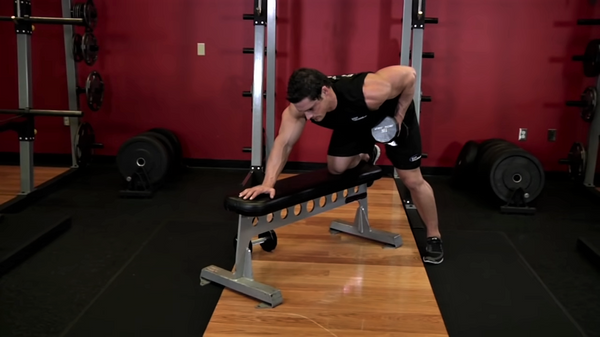
Support from a bench lets you focus on range and load with less demand on the lower back.
- Set up: Brace one hand and knee on a bench; plant the opposite foot firmly.
- Move: Pull the elbow toward the hip and lower under control.
- Form cue: Do not shrug the shoulder toward the ear.
Programming: 3 sets of 8–15 per side.
5. Renegade Row

The renegade row combines upper-back work with demanding trunk stability.
- Set up: Use stable hex dumbbells and a wide-foot high plank; beginners can elevate the hands.
- Move: Row one weight while resisting rotation, then switch sides.
- Form cue: Reduce the load if the hips twist.
Programming: 2–3 sets of 5–8 per side.
6. Reverse Fly

A light reverse fly targets the rear shoulders and upper-back muscles through shoulder horizontal abduction.
- Set up: Hinge and hold light dumbbells with elbows softly bent.
- Move: Open the arms until they align roughly with the torso, then return slowly.
- Form cue: Lead with the elbows and avoid shrugging.
Programming: 2–3 sets of 12–20.
7. Incline Bench Row

Chest support removes much of the temptation to swing and makes the exercise easy to standardize.
- Set up: Lie chest-down on a low incline bench with feet planted.
- Move: Row toward the ribs, pause, and lower fully.
- Form cue: Keep the chest connected to the pad.
Programming: 3 sets of 8–12.
8. Dumbbell Pullover

The pullover trains the lats through a long arc while also involving the chest and triceps.
- Set up: Lie on a bench and hold one dumbbell above the chest with slightly bent elbows.
- Move: Lower behind the head only as far as the shoulders stay comfortable, then return.
- Form cue: Keep the ribs down and use a controlled range.
Programming: 2–3 sets of 10–15.
A Complete Dumbbell Back Workout
Use one heavy stable row first, then add unilateral and rear-shoulder work.
| Exercise | Sets × reps | Rest |
|---|---|---|
| Chest-supported or bent-over row | 3 × 8–12 | 75–90 sec |
| One-arm row | 3 × 10/side | 60 sec |
| Dumbbell pullover | 2 × 10–15 | 60 sec |
| Reverse fly | 2 × 15–20 | 45 sec |
How to Progress Safely
- Add repetitions before increasing load.
- Use a bench-supported variation if the lower back tires before the target muscles.
- Keep one or two repetitions in reserve on compound rows.
- Train the back one to three times weekly depending on total pulling volume and recovery.
Frequently Asked Questions
Can dumbbells build a strong back?
Yes. Dumbbells allow progressive rows, pullovers, and rear-delt work. The main requirement is access to enough resistance as strength improves.
Which exercise is best for beginners?
A bench-supported one-arm row is easy to set up and keeps the torso stable while you learn the pulling path.
Why do I feel rows in my arms?
The biceps assist every row. Use a lighter load, initiate by moving the elbow, and avoid curling the weight toward the shoulder.
The Bottom Line
Choose a few complementary movements, track them, and progress gradually. Pair adjustable dumbbells with an adjustable bench for more supported variations.
Editorial note: This guide is educational and does not replace individualized advice from a qualified health or fitness professional. Sources: CDC physical activity guidance

