

Deadlift and Its Variations: Perfect Exercises for Your Backside
Looking to build serious strength in your posterior chain? The deadlift and its variations are among the most effective compound exercises for developing powerful hips, legs, and back muscles. Whether you're a beginner wondering "is deadlift for back or legs?" or an experienced lifter exploring different deadlift types, understanding these variations will help you target specific muscle groups and break through training plateaus.
Deadlifts can be really difficult for weight-lifting newbies because they require lifting a heavy weight. Besides, if you do it wrong, you may injure your waist or experience muscle cramping. That's why mastering proper form with lighter weights before progressing is crucial. Here, we will introduce the deadlift and its 4 variations so you can have a first try at deadlifts and explore more about this popular muscle-building exercise. Here we go!
Understanding Deadlift Variations
Before diving into specific deadlift variations, it's important to understand that each variation shifts the emphasis to different muscle groups. The conventional deadlift targets your entire posterior chain, while variations like Romanian deadlifts isolate your hamstrings more intensely. Single-leg variations challenge your balance and core stability, making them excellent for functional fitness and athletic performance.
Ready to start your deadlift journey? Check out our adjustable dumbbell sets – perfect for mastering deadlift form at home before moving to heavier weights.

1. Conventional Deadlift
It mainly targets your lats and glutes, and also works your hamstrings.

- Stand with your feet hip-distance apart and put the barbell in front of your feet.
- Screw the feet into the floor, creating a strong tension through the glutes.
- Bend down and grip the bar with your hands just outside the knees.
- Lower your hips slightly to hinge at the hips, and contract your lats as you pick up the weight.
- Lock your weight as you stand up, keeping your torso neutral.
- Stretch your spine and squat the weight back down.
2. Dumbbell Deadlift
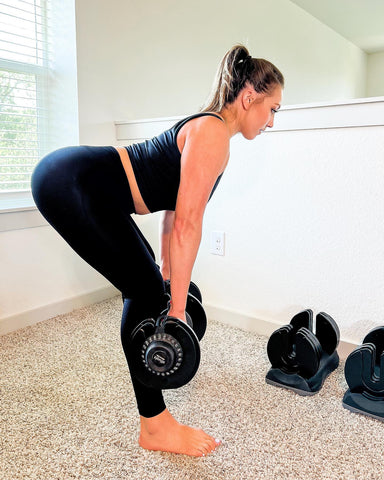
It's basically the same movement as a conventional deadlift, but lifting dumbbells is friendlier for beginners. If the barbell is too heavy for you, you are recommended to start with the dumbbell deadlift. The dumbbell variation offers several advantages: it allows for a more natural grip width, reduces stress on your lower back compared to barbells, and makes it easier to maintain proper form.
Starting with pulling up a dumbbell of 11lbs in each hand, you can experience and reinforce proper deadlift mechanics of the whole process. Then you can level up by switching to a heavier weight or a barbell.
Looking to strengthen your entire upper body? Check out our comprehensive guide on dumbbell pull exercises that complement your deadlift training perfectly.
3. Romanian Deadlift
With this variation, your hamstrings will now be the focus. Differing from a conventional deadlift, it begins in the standing position. The Romanian deadlift (RDL) is one of the most popular deadlift variations for building powerful hamstrings and improving hip hinge mechanics.

- Hold a dumbbell in each hand or a barbell and keep your back straight.
- Start hinging forward at your hips and slightly bend your knees while lowering the weight.
- The weights should follow the line of the legs.
- Contract your glutes and lats muscles to attain back the starting position.
Want to understand the key differences between conventional and Romanian deadlifts? Check out our detailed comparison: Deadlift vs Romanian Deadlift.
4. Single-Leg Deadlift
Stiff-leg deadlifting improves balance and coordination; meanwhile, it strengthens the lower back and torso, along with the muscles in the thighs. This unilateral deadlift variation is excellent for correcting muscle imbalances and enhancing athletic performance, particularly for runners and athletes who need single-leg stability.

- Stand straight with the dumbbell or other weight hanging down the thigh.
- Slightly bend the knees, bow forward, pull the tailbone back, and let the opposite leg kick back while keeping the back straight. Do not lift the leg too high. Square the elevated leg to the floor is just fine.
- Repeat this for the other arm and leg too.
5. Dorian Yates Style Deadlift
Named after legendary bodybuilder Dorian Yates, this deadlift variation keeps constant tension on your muscles throughout the set. It requires you to keep tension on the lower and upper back muscles. So if you are a bodybuilder and intend to build a strong back, perform Dorian deadlifts. The Yates deadlift emphasizes time under tension, making it particularly effective for muscle hypertrophy and developing that thick, powerful back that competitive bodybuilders desire.

The Bottom Line
Deadlift and its four variations work well for building muscle mass. Each deadlift variation offers unique benefits – from the balanced strength development of conventional deadlifts to the hamstring focus of Romanian deadlifts and the back-building power of Dorian Yates deadlifts. However, beginners should exercise with a guide to ensure they focus on the correct form during the whole process. Start with lighter weights using dumbbell deadlifts, master the hip hinge pattern, and gradually progress to heavier loads and more advanced variations. Looking forward to your feedback after following this instruction!
Frequently Asked Questions
Is deadlift for the back or the legs?
Deadlifts work both your back and legs simultaneously. They target your posterior chain, including glutes, hamstrings, lower back, lats, and traps. Different variations shift emphasis – Romanian deadlifts focus more on hamstrings, while Dorian Yates deadlifts emphasize back development.
What are the main deadlift types?
Main deadlift types include conventional (full-body), Romanian (hamstring-focused), sumo (wider stance), trap bar (reduced back stress), single-leg (balance and stability), and Dorian Yates (constant tension). Each variation targets different muscles and training goals.
Which deadlift variation is best for beginners?
Dumbbell deadlifts are best for beginners. They allow lighter starting weights, better form development, and easier hip hinge mechanics. Once you've mastered the movement, progress to conventional barbell deadlifts or other variations.
How do I choose between different deadlift variations?
Choose based on your goals: conventional for overall strength, Romanian for hamstrings, single-leg for balance, and Dorian Yates for muscle growth. You can incorporate multiple variations into your weekly training to target different muscle groups.

